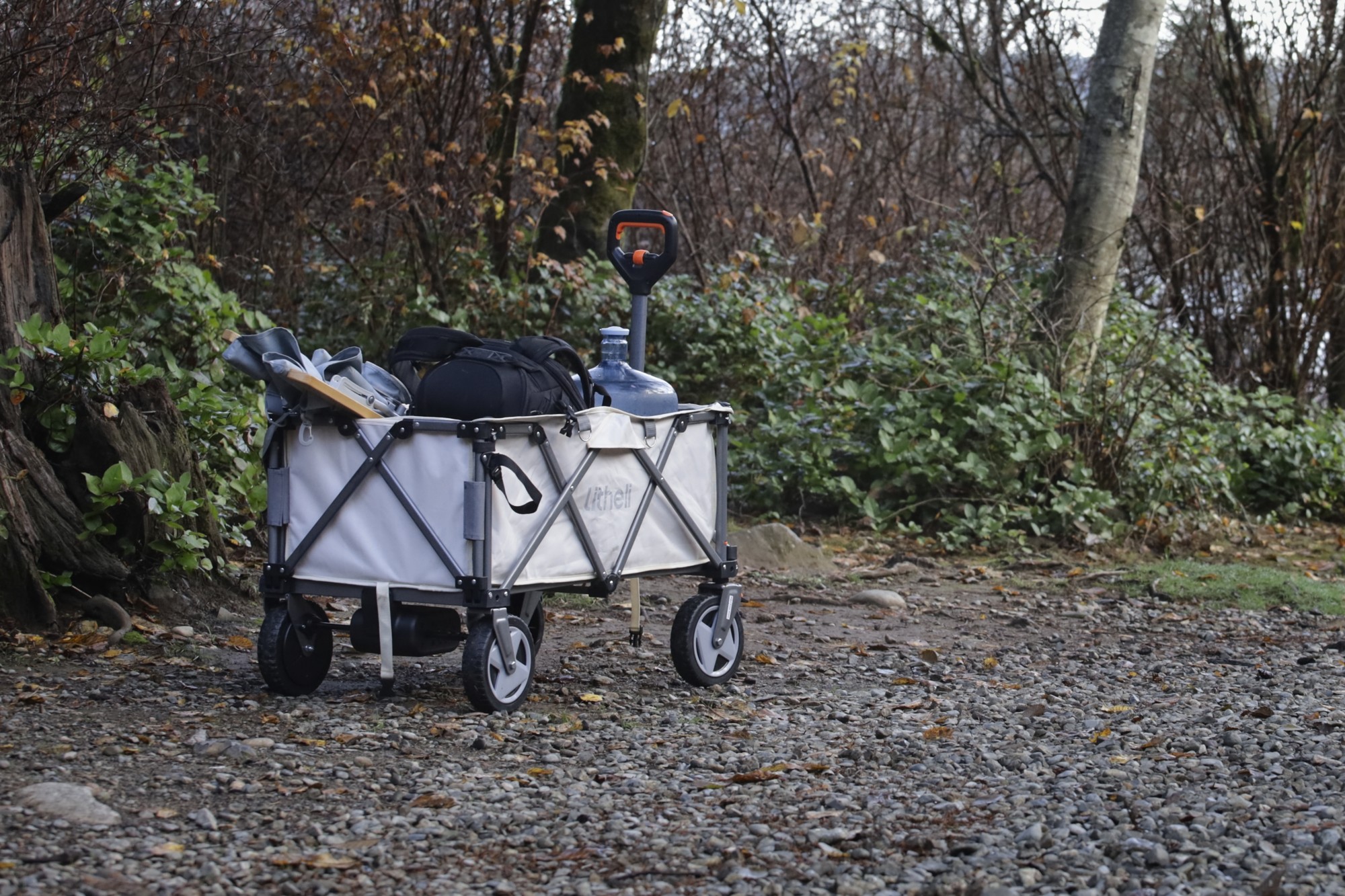
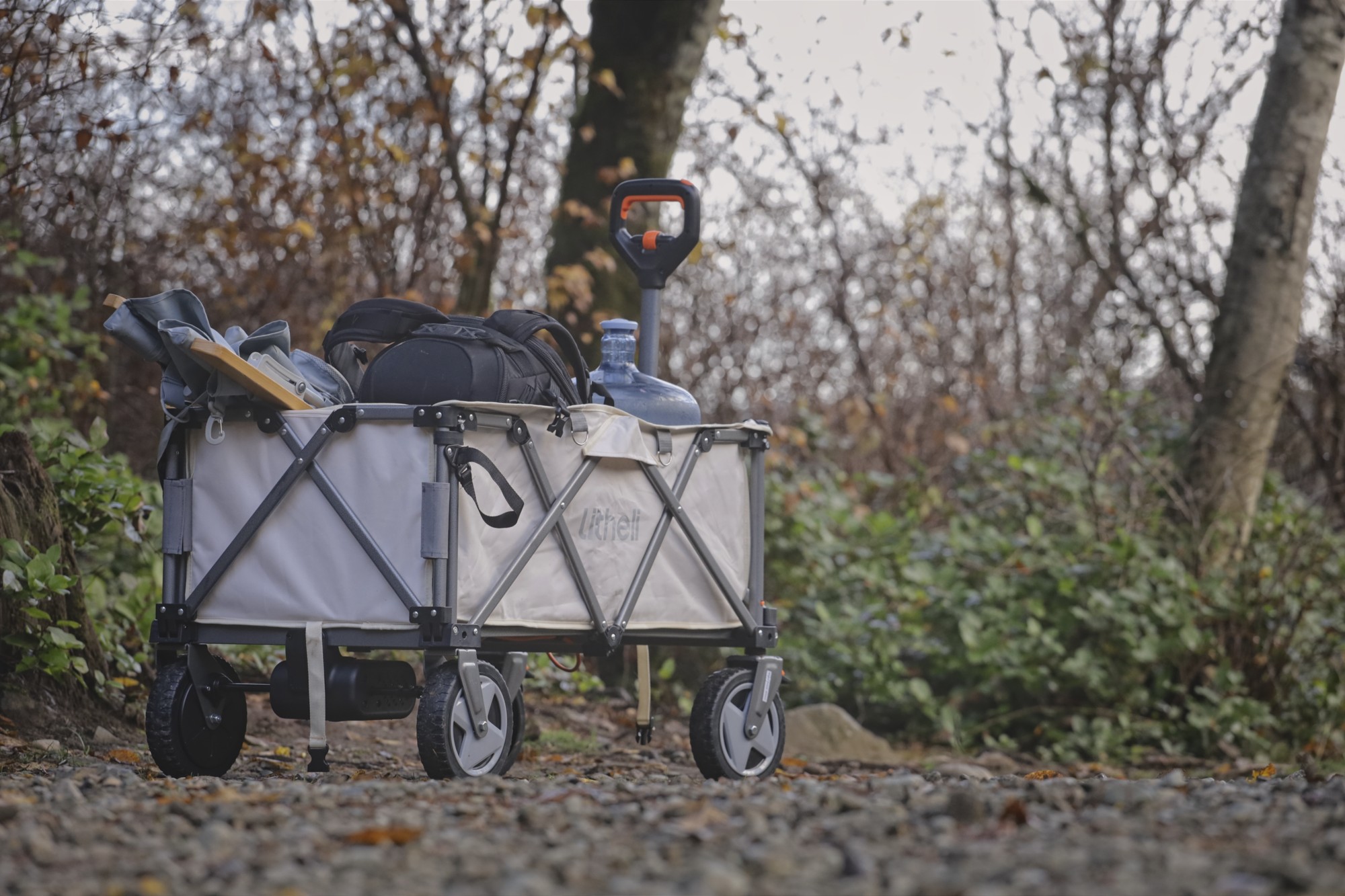
Wagons are great for hauling gear around the campsite and do the beach but they get heavy quickly.
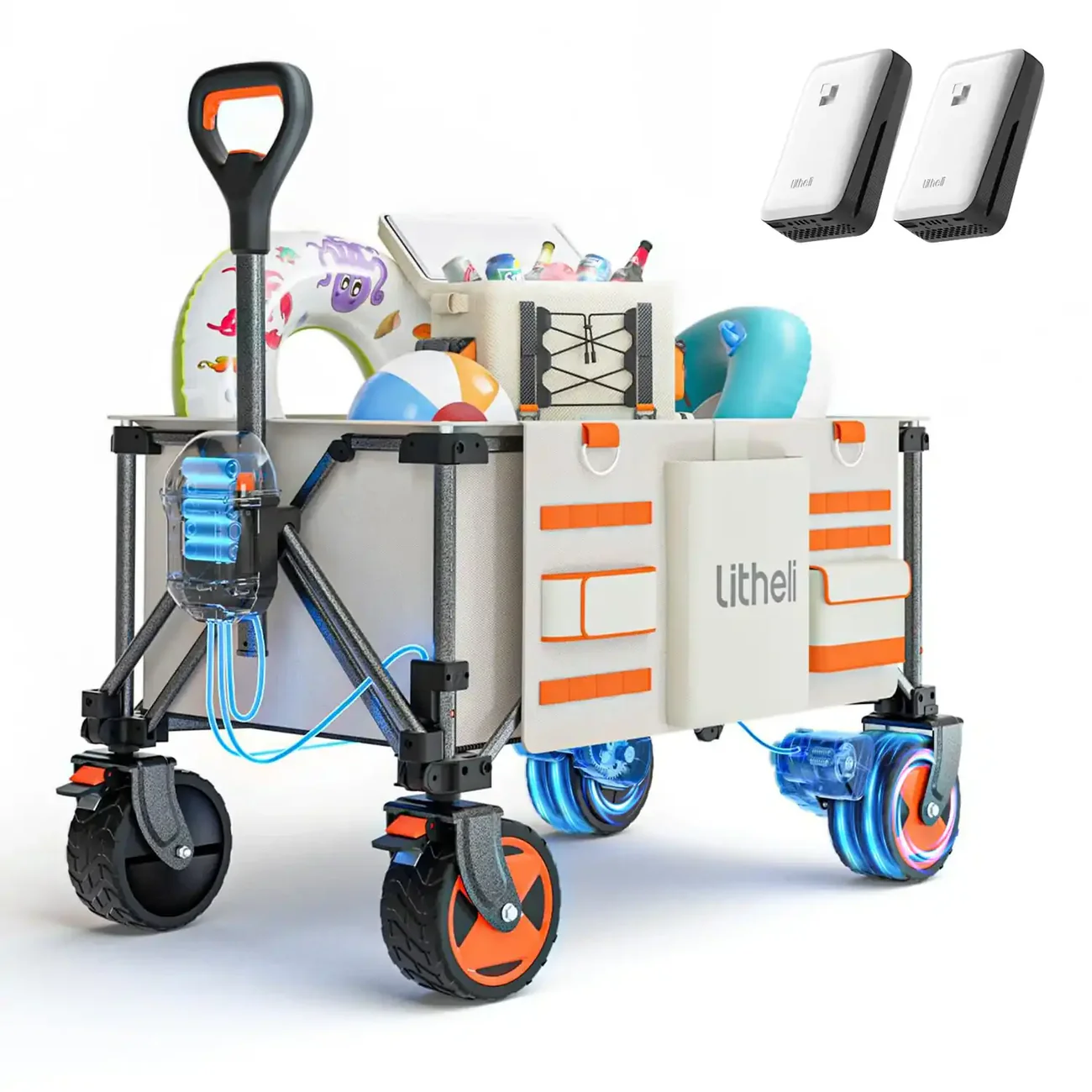
Litheli have an entire ecosystem of power gear and tools used with their U20 20,000 mAh batteries. Along with those tools is a powered wagon capable of moving 130 or 300 pounds, depending on the model.
We tested the W1 Pro wagon with 2 U20 batteries. We dragged 100 pounds around the yard on the grass, concrete paths and rough rocky road to see if a battery and motor on a wagon was worth it.
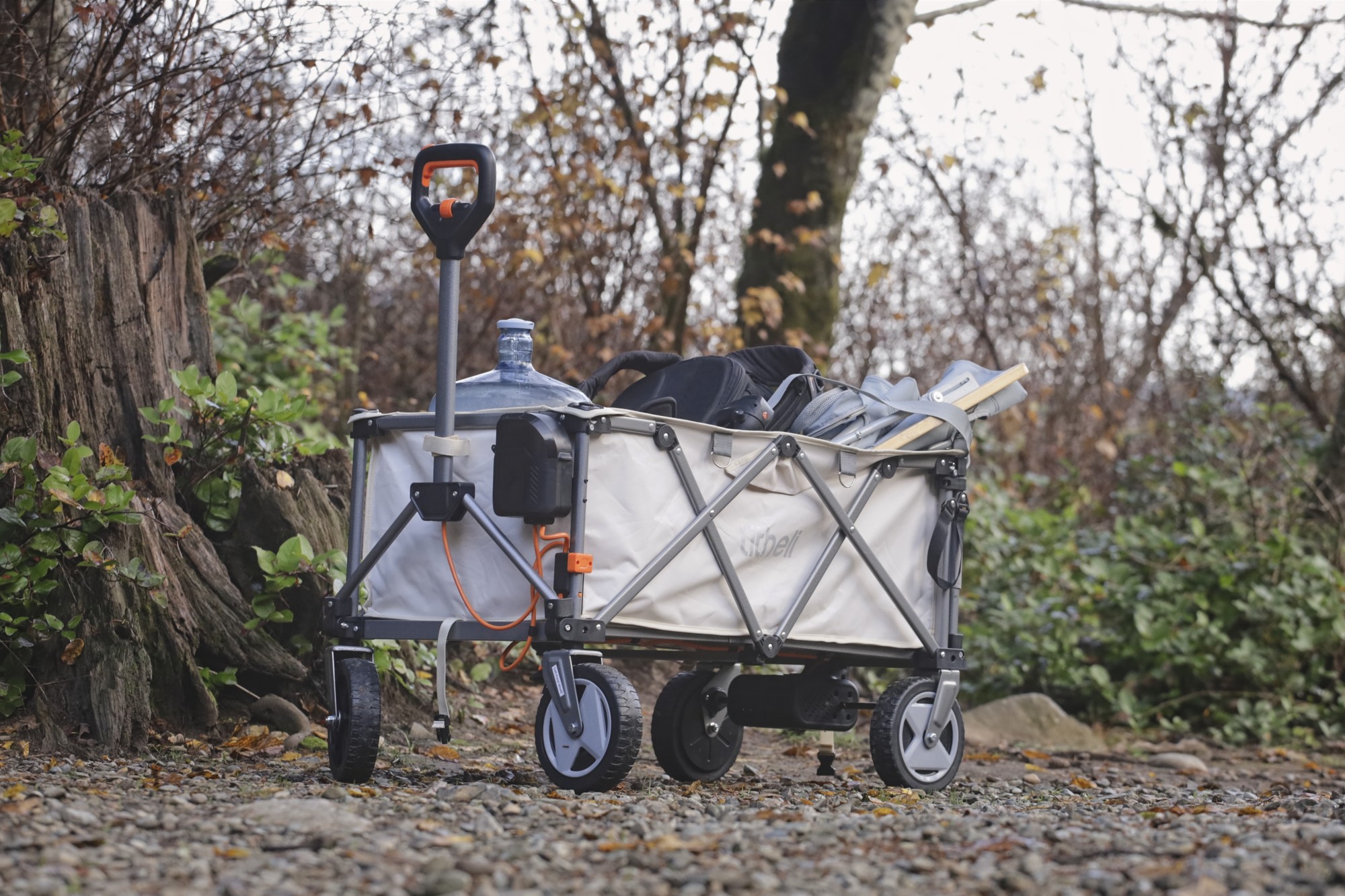
Pros
- Easy to pull with 450 watt electric motor
- Carries up to 132 pounds
- Battery packs work in many other Litheli tools
Cons
- Heavier than regular wagon
- Louder than a regular wagon
Specs
- 15 kg (33 pounds)
- 60 kg load limit (132 pounds)
- 8 inch tires
- how wide for tires?
- .6-1.3 metres/second speed
- Up to 10 degree incline
- 20,000 mAh U20 battery pack (74 Wh)
- 140 L capacity (200L with the tailgate down)
- 600D Oxford fabric
- Unfolded: 40.2” x 27.7 inch x 23.6
- Folded: 25.2 x 12.6 x 30.9
- Range: 30 min (3.4 km)
- Removeable liner
- 4 tie-down d-rings.
Setup
The setup with the wagon was very straightforward. It comes mostly assembled.
It’s packed very well in a fitted box with lots of cardboard to prevent it from bouncing around. I took it out of the box and added the wheels. I charged the batteries to 100% and was ready to roll.
Pulling
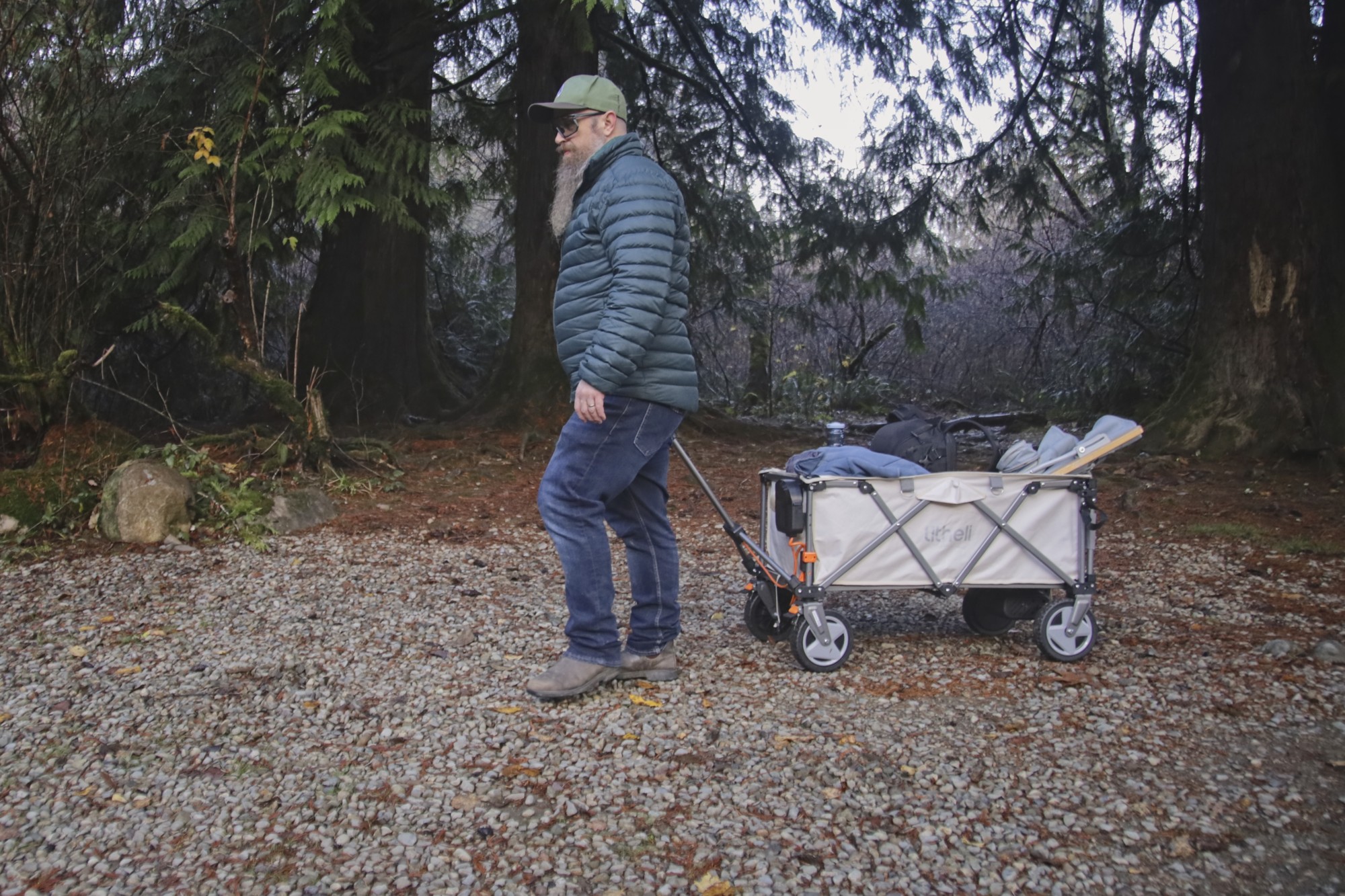
Pulling the W1 Pro is easy. Just pull it. It operates just like a normal wagon.
If you hold the unlock button on the end of the handle and then pull the main lever inside the handle, it will start moving by itself. Let go of the main lever inside the handle and it stops. You can pull without turning it on (non-powered mode) by not holding the unlock button.
My hand was getting tired holding the lock button the whole time until I realized that’s just needed to engage the main lever inside and then you can let go of it.
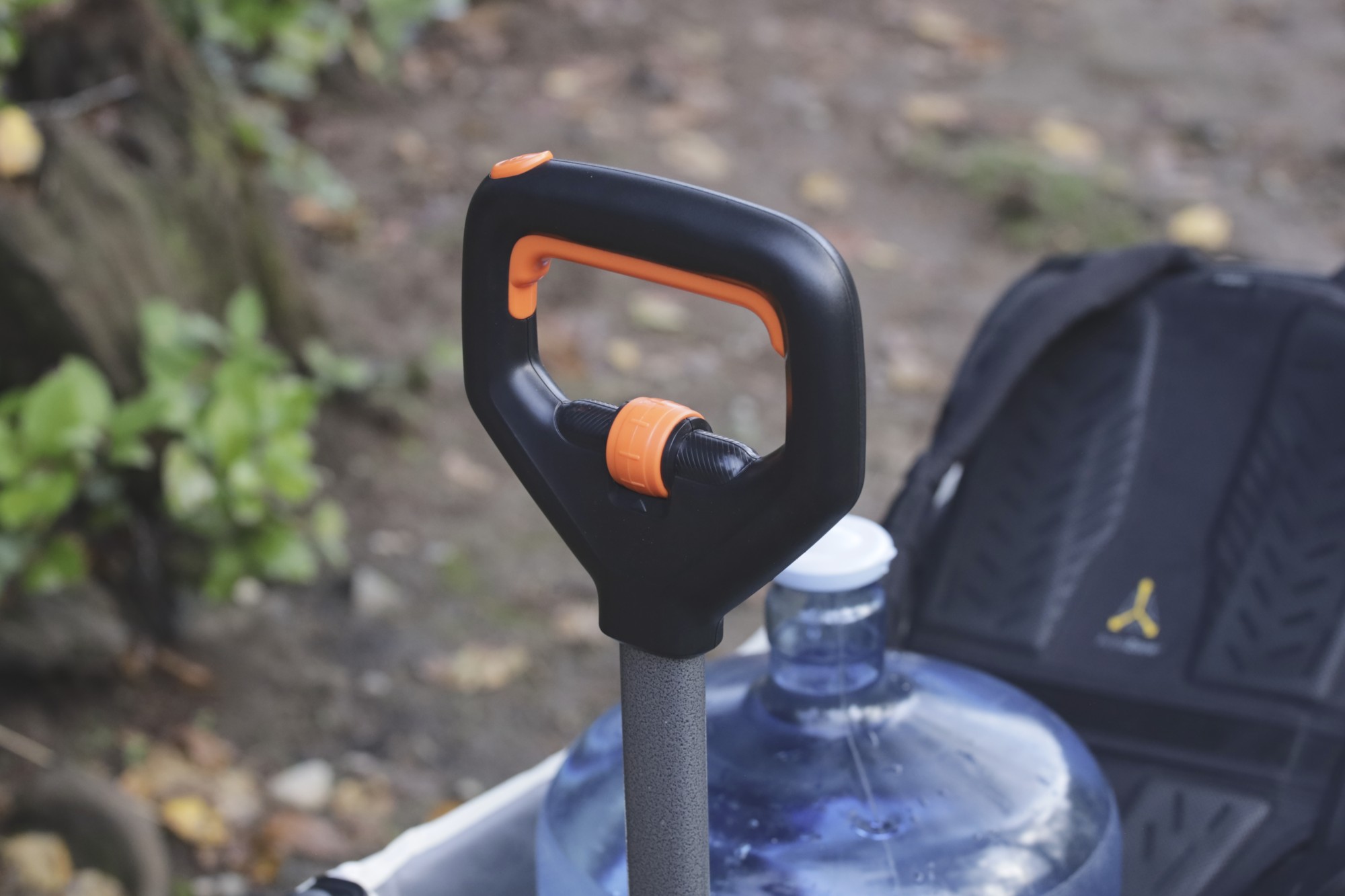
A small dial at the top of the handle sets the speed. It starts at 0.6 m/s or a slow walking speed. The dial stays where you set it well so you don’t have to hold it. 1.3 m/s is the fastest speed or a regular walking speed. I found this a comfortable walking speed. I normally walk a bit faster than this so I wish it could go a little higher on the dial but it didn’t take long to get around.
It is possible to spin the dial for a different speed with the hand that’s already on the wagon but it’s tough. It’s easier to use your other hand or stop and change it.
I did notice with heavy weight, on rough rocky road, the lever inside the handle was engaging without holding the unlock button. It would make a difference if the battery wasn’t in or dead. I was trying to pull it without turn it on to see how it would feel. (Awfully heavy with 100 pounds of gear and the 30 pound wagon!)
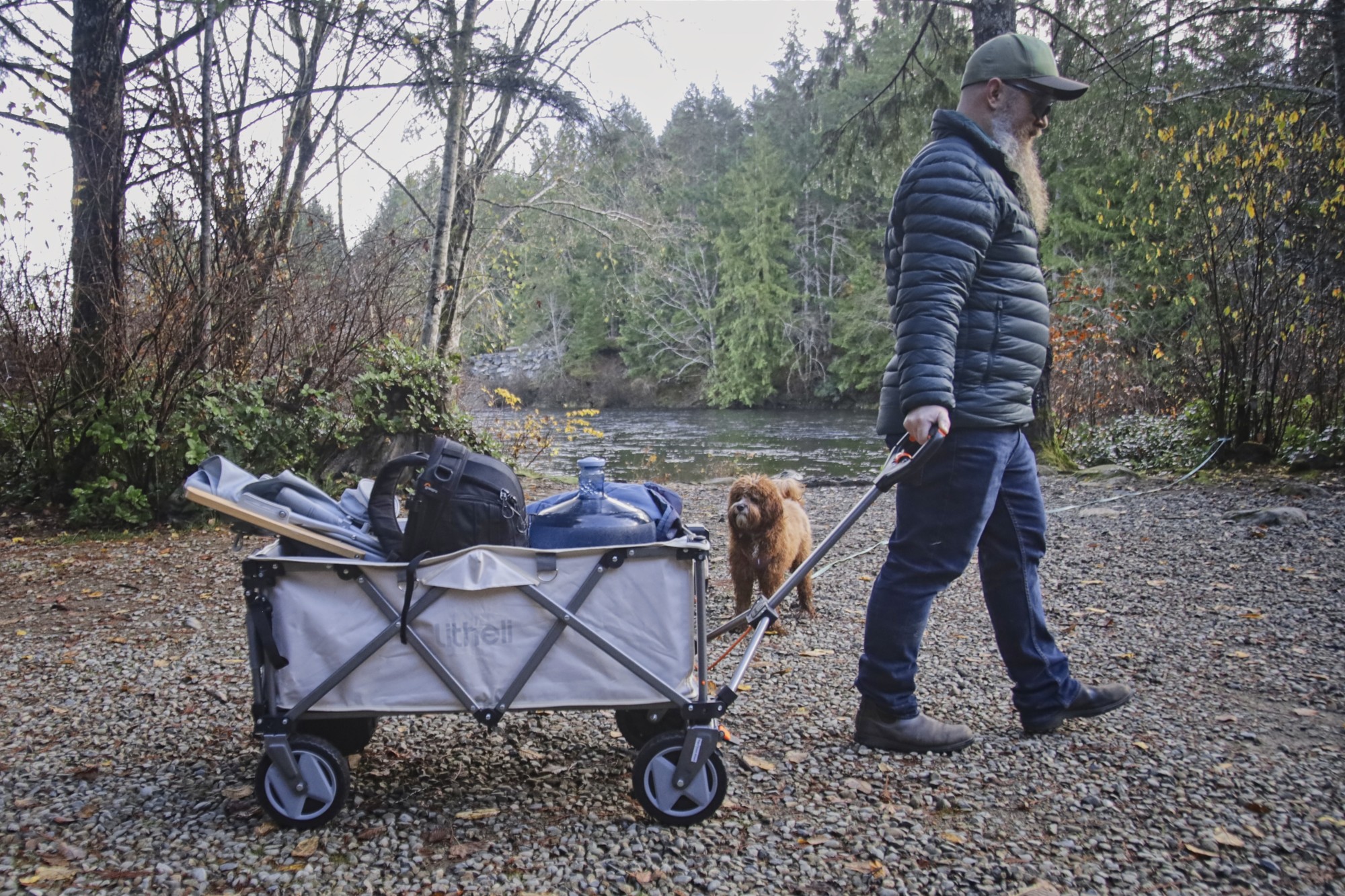
There isn’t a reverse mode so keep that in mind if you’ve got a heavy load. I tested it with 100 pounds and pushing it around with that load was still possible but tough so keep an exit plan in mind when stopping anywhere.
The W1 doesn’t technically have brakes but if the motor is engaged slowly, it will slow it down well. I turned the speed down to it’s slowest going down the hills and it would slow the wagon down. With larger hills and heavier weight it could still get going too fast. For bigger hills I let the wagon go first backwards so I can keep it going slow.
Whenever I stopped the motor would disengage. It was easier on hills to keep it moving slowly with the motor engaged, just like gearing down in a car.
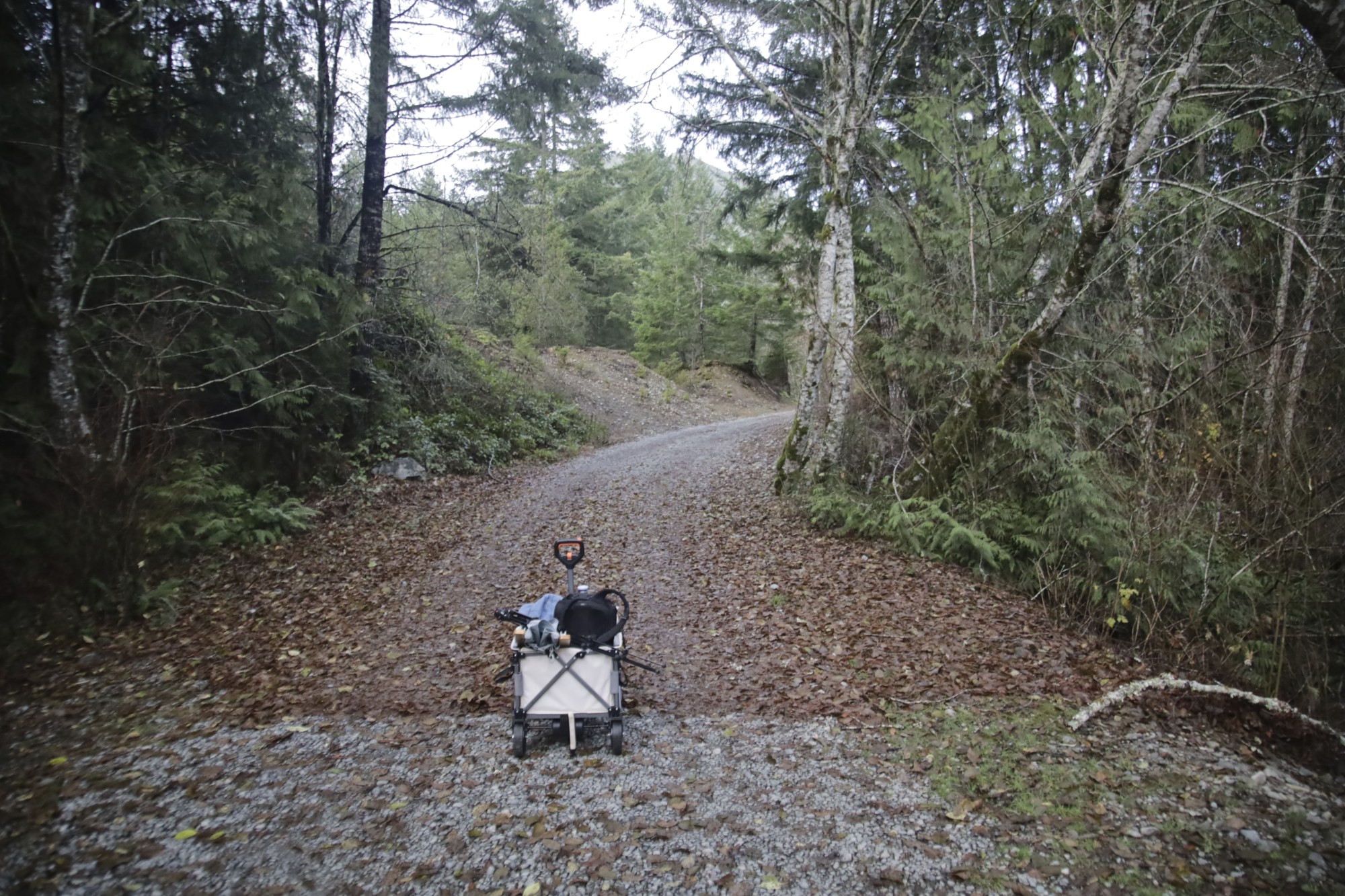
The handle is attached straight to the front of the wagon and doesn’t turn side to side like the old Radio Flyer wagons. This is pretty standard across most utility wagons. The bars feel quite strong but it took a bit of coaxing to get the wheels to turn tightly with lots of weight in the wagon. I’m not sure if a handle that can pivot would work better for tight turns.
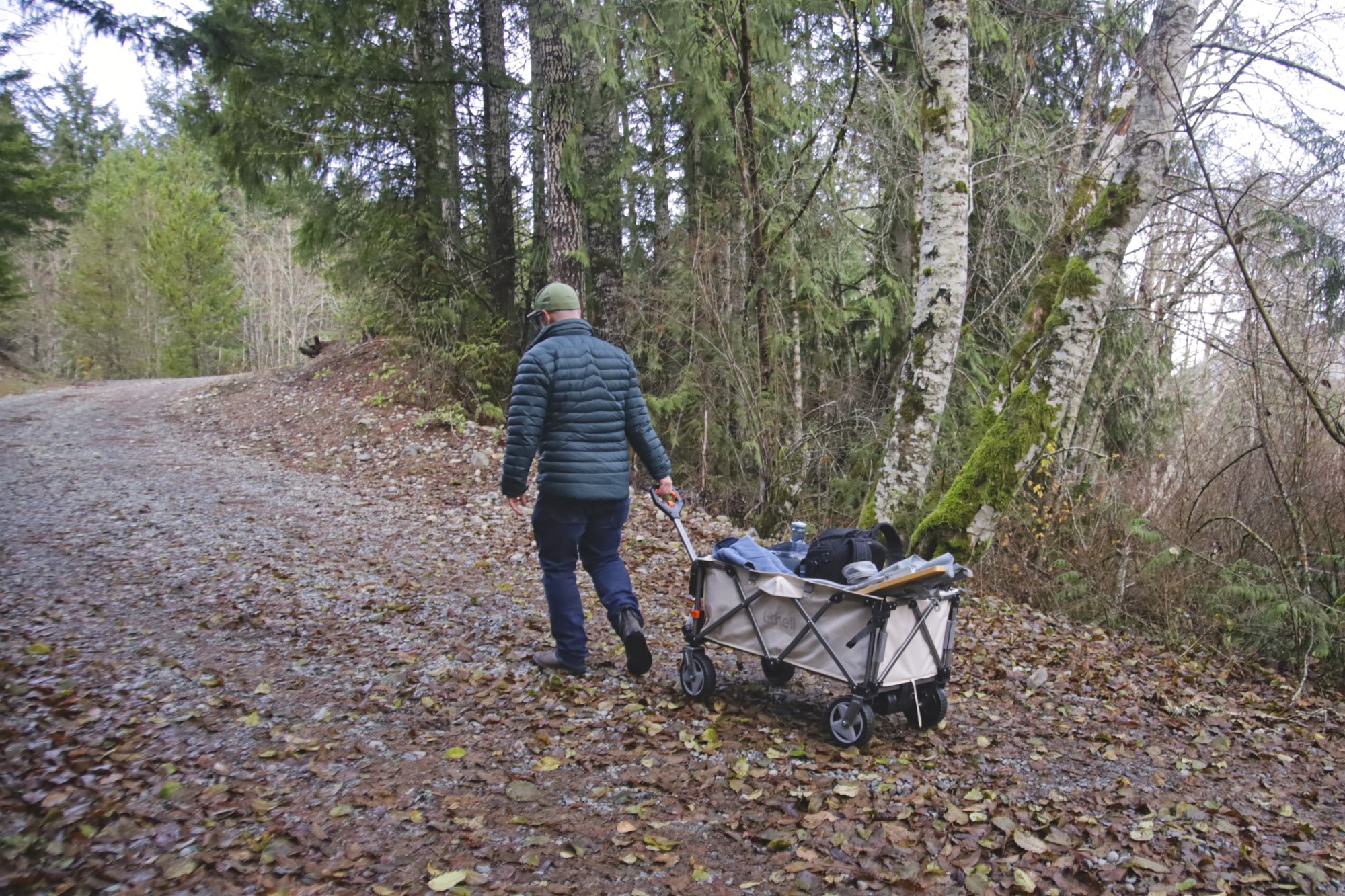
The wheels are strong and have a bit of grip on them. Being hard plastic, they get slippery when they get wet compared to a rubber tire. On wet rocky hills, they slipped but still provided assistance up the hill. I was grateful for this when trying to get back up a big hill when testing to get back to the car!
U20 Battery
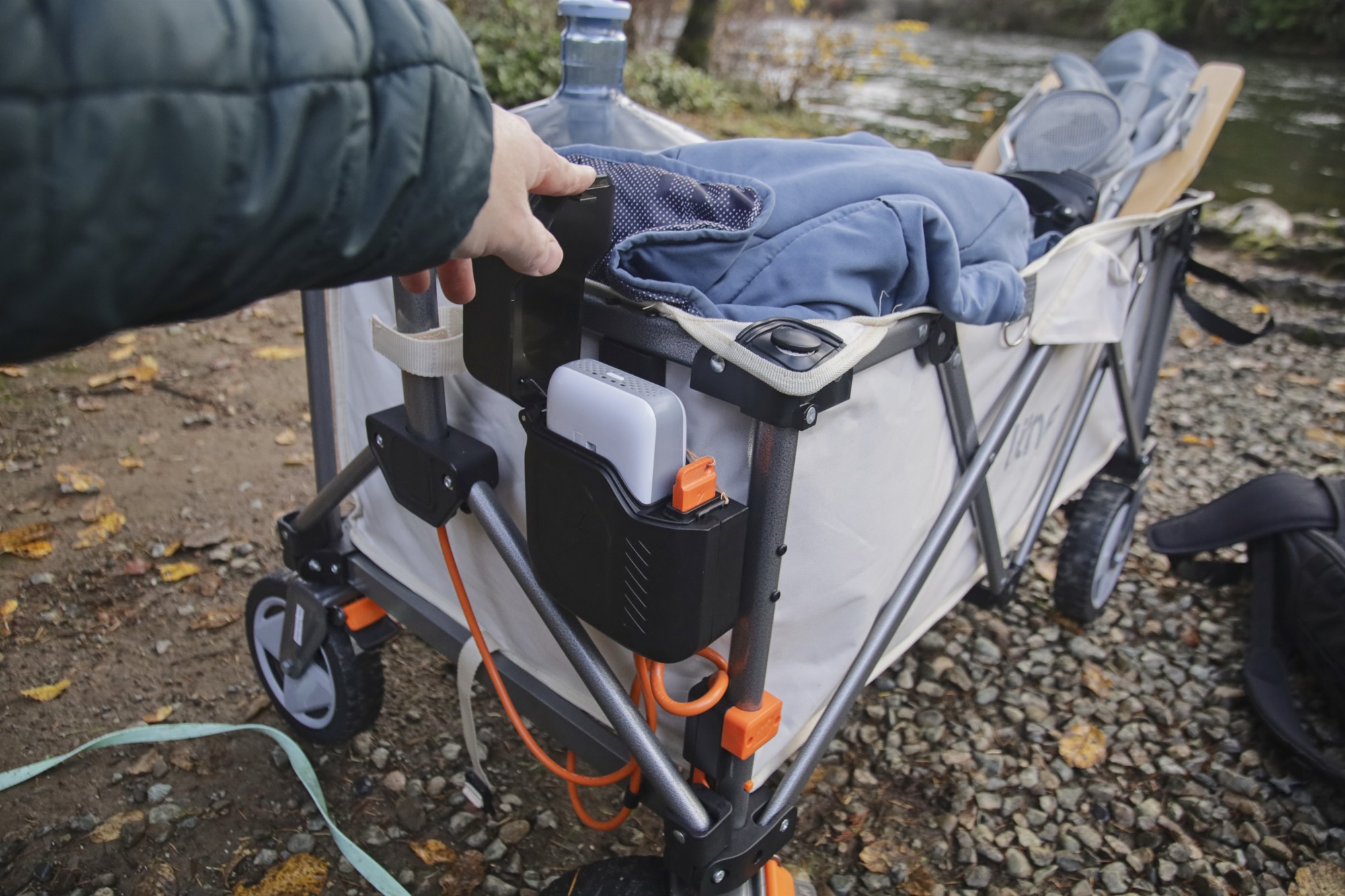
The wagon comes with a U20 battery from Litheli. The U20 is a generic battery that powers many of their power tools. We tested the kit that came with two 4.0 Ah batteries. Different version of the kit come with 1 or 2 batteries. If you already have a bunch of the batteries you can get the wagon alone.
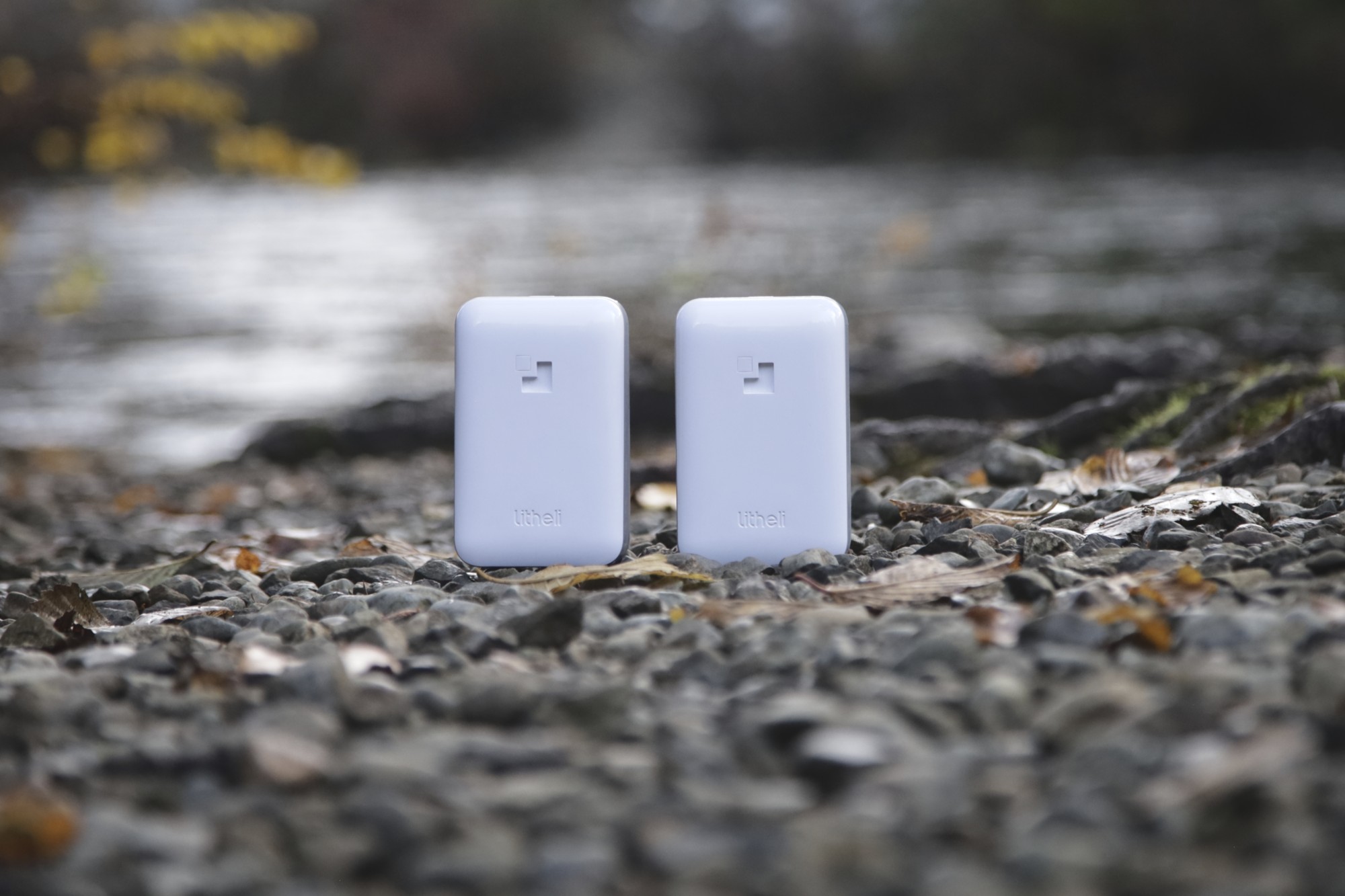
The kits that have batteries come with a power cord but no adapter. I have a bunch of adapters so this was fine. To get the full speed of the charge the adapter has to be 45 watts. Most phone chargers are 5 watts, although 20 watt fast chargers are getting more common. It charges with a 5 watt adapter no problem, just slower.
Along with powering the wagon, it can be used as a power bank with the one 45 watt USB-C port. The USB-C port is on the bottom when it’s plugged into the wagon so you can’t use both at the same time.
The 74 watt-hour rating falls under the limit to fly so you can fly with them. I doubt you’ll be flying with the wagon but the batteries are useful for charging all devices. More USB-C outputs would make it more useful as a general charger though.
The batteries come in 2 sizes: 4.0 Ah and 2.0 Ah. They end up being 20,000 mAh and 10,000 mAh respectively.
Folding
The W1 is easy to fold. There’s a small tab on the bottom in the middle. Just pull up on this and the bottom lifts, the ends slide together and it folds up.
The folding tab isn’t strong enough to carry it with. I tried to lift it there and it starts to tear. It would be nice to have some sort of handle strong enough to carry.
Once it’s folded together, there’s a strap on the bottom to clip the ends together, keeping it folded. It would be easy to use if this clip was on the side or top. It’s easiest to lay it down and clip it together. It does stand up while folded.
The front wheels need to be turned sideways for it to fold to it’s smallest size and the clip to reach. It’s easy to nudge them to the side.
Tailgate
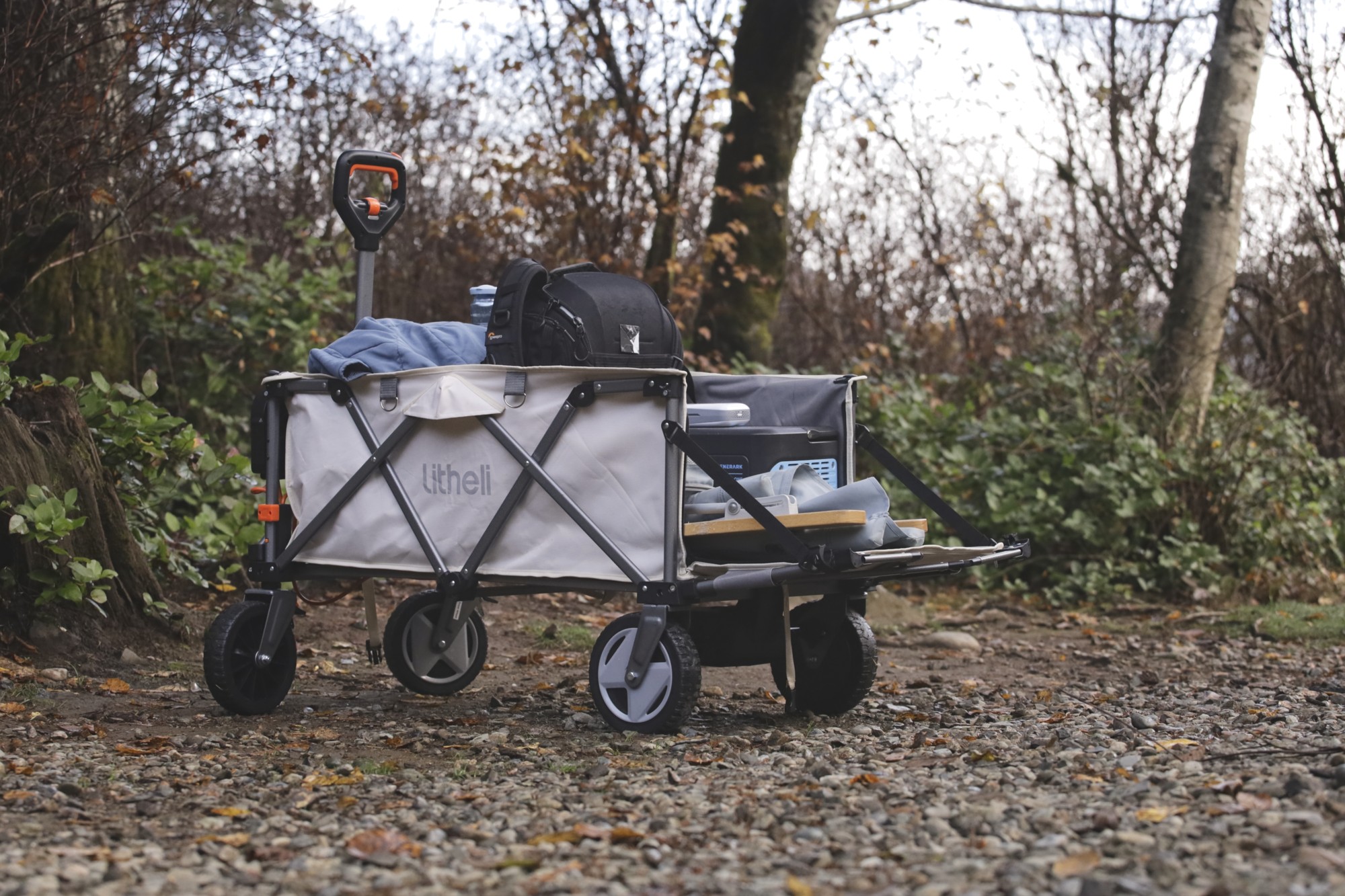
The official capacity of the W1 is 200 liters and that is with the tailgate down. It’s about 140 liters inside with the tailgate up.
The tailgate is great for accessing items in the back without unpacking or just carrying longer items. If there is weight in the front, things like 8 foot 2x4s will fit. If you have the table attachment on top you can still get in the back.
There is a zipper and plastic clips holding it up. Once it’s down, strong webbing holds it flat.
Durability
The 600D Oxford fabric is pretty tough. It’s removable to be able to clean which should extend if it’s life.
Be careful with hard plastic items on rough terrain. I walked a couple kilometers on rough rock. The wagon and everything in it was shaking the whole way. The hard plastic on the bottom of my camp chair was start to wear through. I put a blanket around spots that may rub. Smooth grass and concrete don’t cause much of a problem.
Accessories
Litheli has a few accessories to go with the wagon.
The main accessory that would be useful, as well as with all the other Litheli tools, is more batteries. You can have a few with you if you are carrying a big load or are going a long way.
A rolling table is also available. It clips on to the top. This does make it a bit harder to get things inside the wagon but the tailgate can still open for access.
W2 Pro Electric Wagon
Litheli already have the successor to the W1 Pro out, the W2 Pro and there are some pros and cons.
| W1 Pro | W2 Pro | |
| Weight | 15 kg (33 pounds) | 20 kg (45 pounds) |
| Capacity | 140 L 200 L with tailgate down | 150 L |
| Weight Limit | 60 kg (132 pounds) | 136 kg (300 pounds) |
| Battery life | Litheli U20 4.0 or 2.0 Ah battery 30 min (3.4 km) | Litheli U20 4.0 or 2.0 Ah battery 20 min |
| Speed | 0.6 – 1.3 m/s | 0.6 – 1.3 m/2 |
| Tire size | 8 inch tires | 7 inch tires 3.3 inch wide |
| Motor size | 1 450W motor | 2 450W motor |
| Tailgate | Yes | No |
| Side storage pouch | No | Yes |
| Speed control | Dial | Button |
| Folding | Both ends come together | All 4 corners come together |
| Braking | Wheel brakes Small amount of engine brake | Wheel brakes More engine brake |
| Link | Litheli W1 Pro | Litheli W2 Pro |
Final Thoughts
Wagons are great for carrying loads around the yard, camping or the beach. It’s easy to load them up to be so heavy, they’re almost unusable.
Electric wagons solve this problem with their batteries and electric motors so you easily pull around hundreds of pounds by just holding the button on the handle.
The Lithei W1 Pro (tested here) and W2 Pro are almost 2 different wagons, with different features. Both are strong, durable and very easy to put together and use.
The W1 we tested powered through dirt, sand, gravel and rocky road with over 100 pounds in it. The bouncing started to wear a hole in the fabric when something sharp is against it but it slogged up hills and over rocks no problem.
The biggest difference between the W1 and W2 are the motors and weight capacity. A single 450 watt motor on the W1 while the W2 has 2. The power and frame increases the weight capacity from 132 pounds on the W1 to 300 pounds on the W2. This all comes at a cost of battery life: 20 min on the W2 vs 30 on the W2. Either way 2 batteries and a station to charge is very helpful to swap out as needed.
For me, the extra range and tailgate gives the W1 the edge and my preference, though I’d love a combination of the 2, taking the best of both.
On top of the W1 Pro being a solid wagon for dragging around very heavy loads, the U20 batteries fit all Litheli’s other power tools like snowblowers, lawnmowers, and chainsaws.
Highly recommended.
Price: $596 CAD but can be on sale down to $326 or less.
More photos